Connect Odoo With the Systems Your Business Already Uses
Integrate Odoo with external applications, APIs, marketplaces, payment platforms, logistics systems, and business tools so information can move between systems without unnecessary manual work.
We design integrations around your actual business workflows, data requirements, and operational needs.
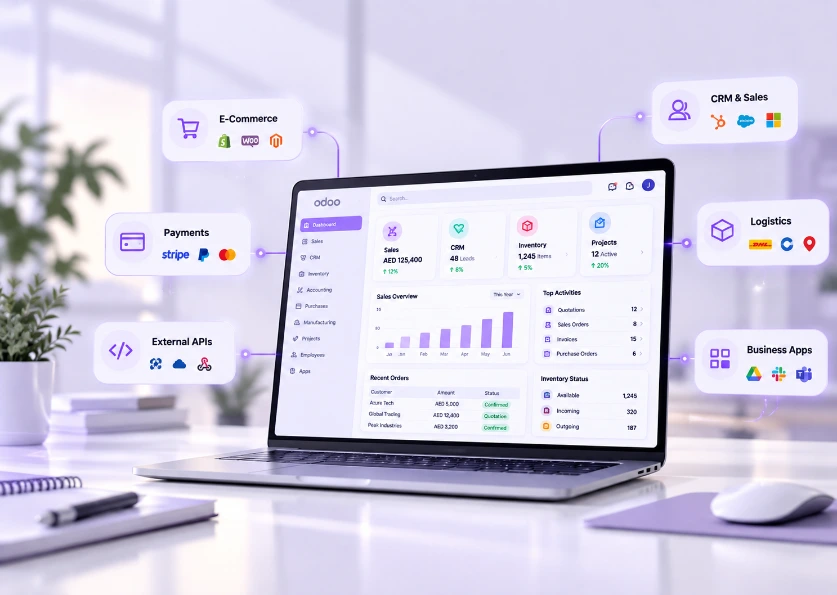
Your Business Systems Should Work Together
Businesses frequently rely on multiple software platforms for different aspects of their operations, from storefronts and CRMs to payment gateways and 3PL shipping providers.
When these tools remain disconnected, organizations face duplicate data entry, inconsistent inventory counts, manual spreadsheet transfers, delayed order fulfillment, and blind spots in financial reporting.
We believe integration should be designed around your actual business processes, ensuring reliable data synchronization, automated handoffs, and a single source of operational truth.
Connected Data Flow Architecture
Connect Odoo Across Your Technology Environment
Bridging your core ERP with the external tools, platforms, and services that drive your business.
E-Commerce Integration
Connect online stores and marketplaces with Odoo for products, customers, orders, inventory, and fulfillment.
API Integration
Connect Odoo with third-party applications and services through APIs and structured data exchange.
Payment Integration
Connect payment platforms and gateways with Odoo to streamline payment and transaction workflows.
Logistics & Shipping
Connect logistics, courier, shipping, and fulfillment systems with Odoo.
CRM & Business Applications
Connect CRM, customer platforms, operational tools, and other business applications.
Hardware & Operational Systems
Connect Odoo with relevant hardware, devices, or operational systems where required.
A Practical Approach to Odoo Integration
Reliable integration starts with understanding the business process and the data that needs to move between systems.
Understand
Identify the systems involved, business workflows, data requirements, users, and operational challenges.
Map
Define what information needs to move, when it should move, and which system should remain the source of truth.
Connect
Build the required APIs, connectors, synchronization logic, validations, and workflows.
Test & Monitor
Validate real business scenarios, handle exceptions, monitor synchronization, and refine the integration where required.
Integration Should Reduce Work, Not Add Complexity
Clear operational outcomes delivered by robust, well-architected system connections:
Reduce Duplicate Data Entry
Eliminate manual re-keying across separate platforms, freeing team time for high-value business tasks.
Keep Information Synchronized
Ensure inventory counts, order statuses, and customer records remain consistent everywhere in real time.
Improve Operational Visibility
Give management comprehensive end-to-end reporting across sales, procurement, operations, and finance.
Connect Teams and Systems
Bridge departments so sales, warehouse, fulfillment, and accounting work together with unified data.
Reduce Manual Errors
Prevent shipping mistakes, missed invoices, and mismatched financial records caused by manual entry.
Support Scalable Workflows
Handle multiplying transaction volumes and new sales channels without needing proportional administrative overhead.
Where Odoo Integration Can Make a Difference
Common real-world integration architectures we implement for growing businesses:
E-Commerce to Odoo
Automatically bring customers, orders, products, and inventory information into Odoo.
CRM to Odoo
Connect customer and sales information across systems.
Payment to Odoo
Synchronize payment and transaction information with business records.
Logistics to Odoo
Connect shipping, delivery, tracking, and fulfillment workflows.
External Applications to Odoo
Exchange information with specialized business applications.
Multiple Systems to Odoo
Create a connected environment where several systems work together through Odoo.
Integration Designed Around Your Business
Business Process First
We understand the workflow before deciding how systems should communicate.
Reliable Data Flow
We design integrations with validation, synchronization, and exception handling in mind.
Practical Architecture
We choose an appropriate integration approach without introducing unnecessary technology.
Long-Term Support
We can continue supporting, monitoring, improving, and extending integrations as your systems evolve.
Built for Businesses With Connected Systems
Tailored for organizations managing multiple technologies that require reliable synchronization:
Cross-System Data Sharing
Multiple systems need to share data reliably without human intervention or data lag.
Manual Data Transfer
Teams are manually transferring information, spreadsheets, and CSV exports between platforms.
E-Commerce ERP Connection
E-commerce platforms need to connect directly with ERP for live inventory and order fulfillment.
Payment & Logistics Sync
Payment gateways or third-party logistics systems need real-time status and financial sync.
Unified Management Data
Management needs consistent, dependable reporting and visibility across all operational platforms.
Scaling Business Ecosystem
Business expansion and multi-channel operations are creating more integration requirements.
Connect Your Systems. Simplify Your Operations.
Tell us which systems you need to connect and what information needs to move between them. We'll help you determine a practical integration approach.